Product
Platform Overview
AXIONA is being designed as a digital system for continuous professional development. At its core lies a shift from managing individual courses and educational events to managing the changes that happen to a person: which competencies they have developed, which tasks they can solve, which outcomes have been verified, and which next development step makes the most sense.
From an Educational Platform to a Development System
A traditional educational platform typically answers the question “what should I study next?” AXIONA considers a broader context: “what does a person need to develop to achieve their professional goal, and how can that outcome be verified?”
AXIONA proposes viewing professional development as a continuous process rather than a sequence of independent courses. The user starts with a goal, progressively builds the necessary competencies, gains practical experience, verifies outcomes, and based on new data determines the further direction of development.
What AXIONA Includes
The system unifies six interconnected areas, each responsible for its part of the professional development process.
Competency Model
A structured description of professional knowledge, skills, and abilities linked to specific development objectives.
Digital Profile
A dynamic representation of a person's professional state: goals, competencies, experience, and verified outcomes.
Adaptive Development
Determining the next development step based on current information about competency state and professional goals.
Competency Verification
Separating the fact of educational activity from verified outcomes linked to professional capability.
Analytics
Analysis of development state and dynamics for better-informed planning of further actions.
Intelligent Services
Leveraging artificial intelligence for information analysis, interaction personalization, and decision-making support.
How the System Components Are Connected
The value of AXIONA lies not in individual features, but in the connections between them. The competency model defines the structure of professional development. The digital profile reflects a person's current state. Adaptive development determines the next step. Competency verification ensures data reliability. Analytics enables observing dynamics. Intelligent services help analyze information and generate recommendations.
For Individuals
For professionals, AXIONA transforms professional development from a set of disconnected activities into a clear coordinate system. Users gain the ability to see not just a list of completed courses, but a holistic picture of their professional state.
- A holistic view of professional development.
- Visual competency state and dynamics.
- Learning connected to professional goals.
- Recording verified outcomes and achievements.
- Personalized trajectory for continued development.
For Organizations
For organizations, the competency model creates a foundation for clearer conversations about professional requirements, employee development, and existing competency gaps.
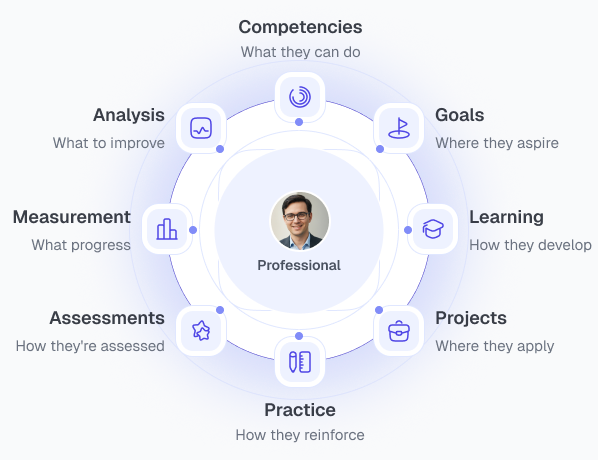
“AXIONA views development as a continuous, data-driven process, not as a sequence of educational events.”
Product
Competency Model
Why competencies are the central unit of the AXIONA model.
In AXIONA, a competency is not simply an entry in a skills list, but a structured description of a person's ability to apply knowledge and experience to solve professional tasks. The competency model connects a person's professional goals with specific areas of development. It helps identify which abilities are already formed, which require development, and which outcomes can serve as evidence of their mastery.
This approach matters because the same amount of completed materials can correspond to vastly different levels of actual proficiency. AXIONA therefore treats learning content as a means of development, not as an end result. The competency model also creates a common language between the professional, the organization, and the educational environment. A professional goal can be described through a set of competencies, and development — through changes in their state.
Competency as a Measurable Unit of Development
Each competency can be evaluated through its current state, target level, and supporting evidence.
This enables a shift from the abstract “studying a topic” to the question of which professional capability a person has acquired or developed.
Relationships Between Competencies
AXIONA is designed with the understanding that professional capabilities are interconnected. Some competencies serve as the foundation for others, some reinforce each other, and certain skills are necessary to achieve more complex professional goals.
Isolated Skill
Described separately, without connections to others.
Competency in AXIONA Model
Connected to dependent and reinforcing competencies.
Isolated Skill
Assessed in isolation.
Competency in AXIONA Model
Assessed in the context of professional goals.
Isolated Skill
Development does not affect adjacent areas.
Competency in AXIONA Model
Developing one competency can unlock pathways to others.
Platform Status
AXIONA is at the design and technology product formation stage. The concept, methodology, and architectural model have been largely established, while individual mechanisms are in the process of development and validation.
The capabilities described in the documentation reflect AXIONA's target model and should not be interpreted as a claim that all features are available in production.
Next Level — Digital Profile
The competency model defines the structure of professional development. But for the system to accompany a person, it needs to know their current state. The next chapter is dedicated to the digital profile — a dynamic representation of professional development.
What the Profile Reflects
The AXIONA digital profile is designed to represent a person's professional state dynamically. It connects goals, competencies, experience, and verified development outcomes into a unified picture.
In traditional educational systems, a profile is often limited to course completion history and earned certificates. Such data shows what a person has been doing, but does not necessarily show what they can actually do. In AXIONA, the digital profile is viewed as an evolving model of professional state.
What the Digital Profile Reflects
The digital profile combines various data categories, forming a holistic view of a person's professional development.
Professional Goals
Selected development directions and target professional roles.
Competency State
Current development level and change history for each competency.
Verified Outcomes
Assessment results, practice outcomes, project deliverables, and other supporting data.
Practical Experience
Projects, work assignments, and professional activities.
Development Dynamics
The sequence of professional state changes over time.
Development Paths
Active and completed professional development trajectories.
Profile as a Living View of Development
A professional profile should not be a static questionnaire. Its value emerges when it reflects a person's changes over time and helps understand not only the current state but also possible directions for further development.
As new outcomes are received, the profile becomes more accurate and useful for making decisions about further development. It shows not only what has been achieved but also helps determine the next most effective step.
Control and Access to Professional Data
Professional information requires special attention to confidentiality and access control. The AXIONA architecture incorporates these requirements as a fundamental part of system design.
The user retains control over their professional data. The digital profile accompanies a person throughout their professional journey and is designed as a personal digital asset.
Foundation for Personalization
The digital profile is one of the key foundations for adaptive development. Profile data is used to determine the next development step, generate recommendations, and analyze progress. The more complete and reliable the profile, the more accurately the system can support professional development.
“The digital profile is a single source of information about a person's professional development that evolves together with them.”
Adaptive Development
Development that accounts for the current state and evolves together with the person.
Adaptive development is one of the core principles of AXIONA. The system is designed so that the next professional development step depends not only on a predetermined program but also on what is already known about the person. If a person already demonstrates a certain competency, they don't necessarily need to repeat the same foundational material. If results reveal a gap, the path may require additional practice, learning, or assessment.
Thus, development is viewed as a cycle: current state → action → new outcome → updated state → next step. This fundamentally differs from a linear educational path where the sequence of actions is predetermined and rarely changes.
The Next Step, Not a Fixed Course
AXIONA is designed around the idea that the system doesn't need to predetermine a person's entire path. What matters more is correctly identifying the next meaningful step based on current information. Traditional educational platforms offer pre-built learning programs. Regardless of how successfully a person masters the material or what experience they already have, the sequence remains unchanged.
What Can Change the Direction of Development
The direction of professional development can be adjusted as new information emerges. AXIONA's intelligent mechanisms analyze the development state and generate recommendations based on current data.
At the same time, artificial intelligence does not define the development model itself and does not replace the person in making significant decisions. Its task is to help analyze factors and propose a well-founded option.
Adaptation Factors
New Outcomes
Verified achievements and completed assessments.
Competency Change
Growth or decline in the level of a specific professional capability.
New Goal
A change in professional goal or development direction.
Practical Experience
Experience gained in projects and professional activities.
Assessment Results
Data from objective knowledge and skill evaluations.
Feedback
Expert opinions and mentor recommendations.
The Role of Intelligent Mechanisms
AXIONA's intelligent mechanisms are designed to help analyze the development state and generate recommendations. At the same time, artificial intelligence does not define the development model itself and does not replace the person in making significant decisions. Its task is to analyze a large number of factors, propose the most well-founded development option, and explain the reasoning behind its suggestion.
The Next Meaningful Action
AXIONA does not attempt to pre-build a complete professional development path. Instead, the system identifies the next most meaningful step that brings the person closer to their professional goal based on the current state.
This action could be learning, completing a project, practice, working with a mentor, competency verification, or any other form of professional development. After each completed action, the profile is updated and the next step is determined.
Recommendation Explainability
Every recommendation must be accompanied by an explanation. The user and organization can see which data the system used, why this particular action was chosen, and how it helps move closer to the professional goal.
Continuous Cycle
After each completed action, the digital profile is updated. The system re-analyzes accumulated data, evaluates changes in competency state, and if necessary adjusts the further direction of development. This cycle repeats throughout the entire professional journey.
“In AXIONA, a development path is never considered complete. It evolves together with the person, adapting to new knowledge, achievements, and professional goals.”
Competency Verification
Why AXIONA separates the fact of learning from the confirmation of the ability to apply knowledge.
For professional development, it is not enough to know that a person studied certain material. It is important to understand whether they can apply the acquired knowledge and skills in a professional context. AXIONA treats competency verification as a separate part of the development system. Learning outcomes, practical assignments, projects, assessments, and other forms of professional activity can serve as sources of supporting evidence.
Such information makes it possible to distinguish the mere fact of educational activity from the outcome it is supposed to produce. Verification should not be perceived as a single exam at the end of a course. Professional competence develops gradually, so its state can be refined as new results emerge.
From Activity to Evidence of Outcomes
Professional development cannot be objectively assessed solely by the amount of materials studied. For quality decision-making, the system needs to understand which knowledge was truly mastered and which abilities a person can demonstrate.
Therefore, AXIONA treats learning as one of the possible sources of competency formation, but not as proof of its existence.
Diversity of Supporting Evidence
Depending on the competency, verification may rely on different types of results. Each type carries information about the origin and reliability of the data.
Course Completed
Demonstrated ability to apply knowledge.
Test Completed
The state of a specific competency has been assessed.
Certificate Earned
Supporting results linked to professional capability exist.
Practical Assignments
Completed exercises, case studies, and simulations.
Expert Assessment
Evaluations from mentors, instructors, and specialists.
Project Experience
Verified results of professional activity.
Result Reliability
Not all supporting evidence carries equal value. AXIONA is designed to analyze the origin of information, the method of its acquisition, and its level of objectivity. This allows distinguishing between preliminary data and results that have undergone objective verification.
The higher the quality of verified data, the more confidently the system can build recommendations and assess the state of professional development.
Why This Matters
Verified results make the digital profile more substantive and create a foundation for more precise decisions about further development. Data quality determines the quality of recommendations and adaptive guidance.
Separating the fact of educational activity from verified professional outcomes is one of AXIONA's key architectural principles.
Foundation of Adaptive Development
AXIONA's intelligent mechanisms make decisions based on verified information. When objective results are available, the system uses them instead of assumptions.
As new verified data emerges, the digital profile is updated, and the system re-analyzes the development state and adjusts recommendations if necessary.
Trust in Data
AXIONA is built around the principle of trustworthy information. It is the quality of data that enables the platform to support professional development, generate explainable recommendations, and help organizations make informed decisions.
“The quality of development decisions is determined by the quality of data they are based on. Verified results enable truly reliable decision-making.”
User Experience
How all previous concepts come together into a clear user experience.
AXIONA should be perceived not as a course catalog, but as a working environment where a person understands their own professional goal, sees the current development state, and receives a clear next step. The user experience is built around a continuous development cycle. At the center is the professional goal, around it — competencies and current tasks, and educational and practical activities become tools for moving to the next state.
The interface should show not only what has been done, but also explain why the system suggests a particular action and how it relates to the professional goal. For the user, this means transitioning from searching for the next course to managing their own development. For the organization — the ability to see specialist development as a connected process.
Focus on the Next Action
AXIONA should not overwhelm the user with all possible educational information at once. The main interface should help understand the current state and identify the next most relevant step.
Explainable Recommendations
If the system suggests an action, the user must understand its connection to the current state and professional goal. A recommendation is valuable not only for the suggestion itself, but also for its clear explanation of purpose.
Unified Development Picture
Goals, competencies, profile, outcomes, development, and recommendations should be perceived as parts of a single process. This very coherence distinguishes AXIONA from a set of independent educational tools.
Every completed action updates the digital profile and initiates the next analysis cycle. Interaction with the platform becomes a continuous professional development process.
System Transparency
Every recommendation is accompanied by an explanation of the reasons behind it. The user understands which data was used, why this particular action was chosen, and how it helps move closer to the professional goal.
User Experience Principles
AXIONA accompanies the user throughout their professional journey. Every interface element is subordinated to a single task — helping a person manage their own development.
Unified Context
All development processes take place within a shared digital environment.
Personalization
Every path is formed based on the digital profile.
Continuity
Development is accompanied by the system throughout the entire professional life.
Explainability
Every recommendation is accompanied by a clear explanation of reasons.
Evidence-Based
All decisions are based on verified results and objective data.
Goal Orientation
Every action is directed toward achieving the professional goal.
Summary
AXIONA's user experience is built around the idea of continuous professional development. Instead of managing the educational process, the platform accompanies a person at every stage of their professional journey — from goal setting to outcome verification and determining the next step.
“AXIONA is a space where a person manages not their learning, but their own professional development.”
 Previous sectionAbout the platformVision and positioning of the AXIONA system.Next sectionTechnologyArchitecture and technology principles of AXIONA.
Have questions? Contact us
hi.axiona@protonmail.com